

First of all, the disclaimer: I am invested in LENSAR Inc. ($LNSR). Nothing I write should be considered investment advice.
Ticker: LNSR
Price: USD 8.27
Shares Outstanding: 12.28m (fully diluted 27.35m)
Market Cap: $101.55m (fully diluted $226.16m)
Enterprise Value: $191.1m
Here is what I wrote about LENSAR (kept anonymous at the time) in my last quarterly update. As you're reading this now, those assumptions have been confirmed.

I'll keep this pitch as concise as possible. Both the upside and specific risks seem pretty clear at this point, and I just wanted to see the upside confirmed, which yesterday's results did.
The Company
LENSAR developes cataract laser systems and has officially two system types in the field, LENSAR Laser System LLS and Robotic Cataract Laser System ALLY.
ALLY is the next-generation successor to LLS. While LENSAR continues to support the legacy LLS installed base, ALLY is the primary system driving their commercial strategy, which has proven highly successful:1
Since the launch in August of 2022, we grew our installed base to approximately 200 ALLY systems and grew our procedure volume, gaining market share from 14% procedure share in the U.S. to 23.4% as of the end of 2025. I want to say we gained almost 9.5% of market share points in 3.5 years.
Nicholas Curtis, Earnings call Q4 20252
CEO Nicholas Curtis also mentioned the reason for that during the earnings call:
These market share gains come from 3 specific areas. First, it comes from competitive accounts, replacing first-generation lasers with our ALLY Robotic Laser Cataract System accounts for the largest gain in share.
Second, the gain in share is demonstrated by what happens after we replace a competitive system. LENSAR on average performs 27% more procedures annually than the national average per laser, providing evidence that we are growing the overall market for robotic laser cataract procedures. Third, nearly 50% of our systems in Q4 2025 were from Femto-naive surgeons, further expanding the market for laser cataract-assisted surgery. The data provides evidence LENSAR is addressing the shortcomings of the first-generation laser-assisted cataract surgical lasers by delivering the most technologically advanced next-generation robotic laser for cataract surgery in multiple ways.
Nicholas Curtis, Earnings call Q4 2025
The success they had with ALLY is clear if you look at system placements and backlog leading up to Q1 2025:
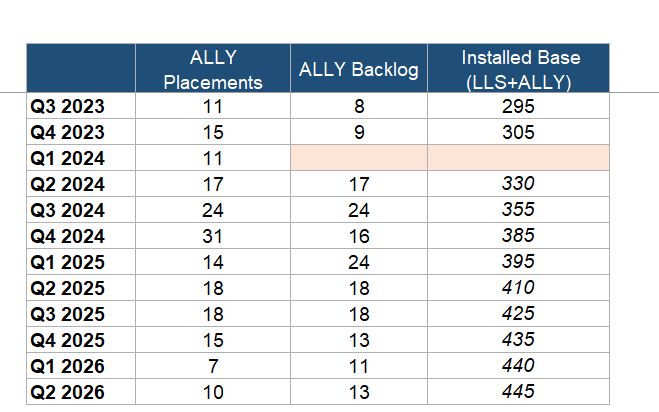
There’s a specific reason I mention Q1. It explains the subsequent drop in stock price, placements, and backlog, but it’s also the exact reason this setup has become interesting again.
The Investment Case
So what went wrong here? From the perspective of a Q1 2025 shareholder back then, everything was going right. Alcon had agreed to acquire LENSAR for total consideration of up to $430M, which represented an 8x multiple on LENSAR's revenue at the time.3
I don’t follow too many rules when it comes to investing, but one rule that sticks with me is: If an acquisition is announced, sell immediately. So many things can go wrong along the way, especially when a company holds relevant market share. Here, the drama started early with the FTC signaling opposition,4 since Alcon is a major competitor5 and combining them would create a dominant player in the FLACS market (femtosecond laser-assisted cataract surgery).
As it became increasingly clear that the FTC might block the deal, both sides agreed to terminate the merger agreement.6
The termination of the acquisition agreement was a mutual pragmatic decision made after a year of focused effort and considerable expense from both sides. While this acquisition was approved overwhelmingly by our stockholders, ultimately, we made the decision to terminate because the Federal Trade Commission would seek to enjoin the merger. While both parties work towards offering acceptable accommodation to allow it to close, it became clear the FTC was not open to changing their position.
Nicholas Curtis, Earnings call Q4 2025
LENSAR’s stock price tanked on the news, dropping well below pre-deal levels. What looked like an overreaction at first makes complete sense when you look at the table above and see how backlog and placements fell off a cliff right after the merger announcement. So what actually caused that operational drop?
The earnings call following the merger termination provided at least part of the explanation:
The uncertainty over the post-acquisition ALLY distribution landscape had a greater impact on our outside United States distributors than our U.S. customers, and that uncertainty caused a meaningful slowdown in our international business expansion over the last year.
[…]
So the business outside U.S. is different in a lot of cases, particularly in a few of the countries where you don't have as many private practice and, let's say, ambulatory surgery center owners where they can make the decision or a private equity group that makes the decision, for example, in Germany, where we have a large private equity group, and we are one of the primary suppliers there. And so in some of the -- particularly Southeast Asia, some of these go on tenders. And given the uncertainty, they were hesitant to engage in a tender because they’re over an extended period of time.So for example, they’ll start reengaging in these tenders and those tenders take time. And quite frankly, we may have lost a few renewals in the short term from some of these deals, not our deals where they had our systems, but where we had an opportunity to, let’s say, quickly replace a competitive system. And so I just expect that it’s going to take us several quarters to really reinvigorate, get out and assess where some of those tenders are, where we have opportunities and begin to do that as well as participating in some of the various conferences like we do here.
And so I just caution to say that -- because we had this massive quick start when we got the ALLY approved 2 years later, now essentially, there’s been 0 activity for the last 9 months and so there’ll be some restart-up. And it’s not like there’s a backlog sitting there because essentially, these distributors didn’t -- again, we’re planning for life without LENSAR that they didn’t expect to be distributing on a going-forward basis
Nicholas Curtis, Earnings call Q4 2025
To me, the order slowdown makes complete sense. ALLY was a direct competitor to Alcon’s legacy platforms, and the plan was to merge sales channels. From a customer or distributor standpoint, why submit a tender for a platform when the future owner, sales support, and long-term product roadmap are all up in the air? It's worth noting that this dynamic mainly applies to international markets, as LENSAR relies on a direct sales force in the US.

So there is zero doubt among management about their mission following the failed merger:
Now that we and our distributors have clarity, I'm confident we can rebuild the strong international presence over time.
Nicholas Curtis, Earnings call Q1 20268
Yesterday’s call showed that this remains a work in progress. To be fair, the CEO was always clear that rebuilding those distribution connections would take a few quarters, as they essentially have to run through the same sales cycles as before. Europe will apparently be one of their key target markets.
So why invest now when we still don’t know if this is going to work out? Because yesterday's results prove that the business, even in its current state, is strong enough to make a compelling case.
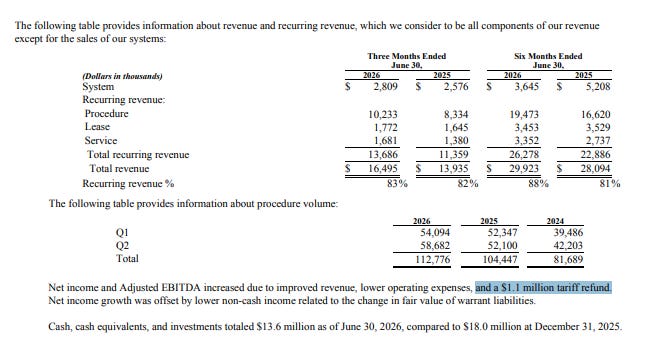
A large chunk of their revenue is recurring, primarily from procedure licenses and consumables used in each procedure.9 Even if you ignore the YoY growth in procedures and recurring revenue, Q2 puts them at an annualized recurring revenue run-rate of roughly $55M, though keep in mind there is seasonality here, with Q3 typically being the weakest quarter due to summer holidays.
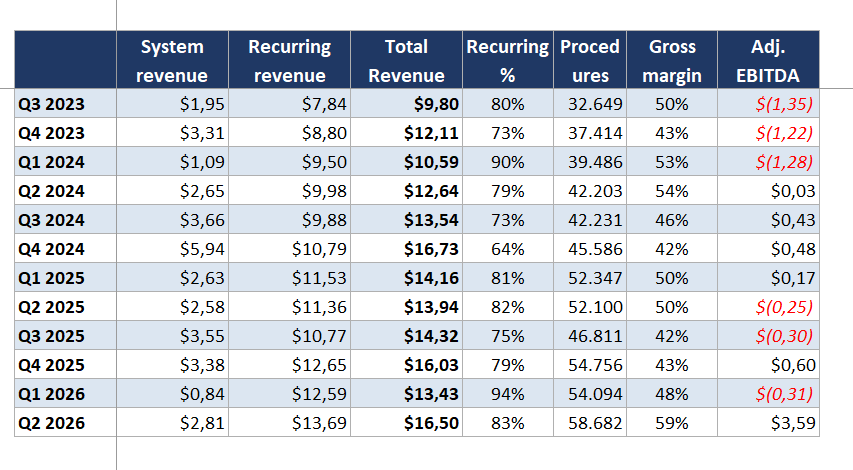
It is worth noting that the plug was pulled on their growth engine while it was running at full steam, leading to significantly lower placements. Current procedure growth from systems in the field shows what is possible if they recover even a fraction of their pre merger placement momentum. ALLY was essentially still in its early stages of market adoption.
What is also impressive is that they managed to operate near EBITDA breakeven while scaling rapidly. The latest quarter gives us a glimpse of what underlying run-rate profitability could look like, though keep in mind that gross margin and Adjusted EBITDA were boosted by a one-time $1.1M tariff refund. Excluding that benefit, gross margin was a healthy 52% with normalized Adjusted EBITDA around $2.5M.10
Valuation
Be aware that while LENSAR is cheap if growth continues, it’s not quite as cheap as the basic market cap on certain financial trackers might suggest. At a stock price around $8.27, a significant number of outstanding warrants and options are in the money, so you need to look at the fully diluted share count to get the true valuation.
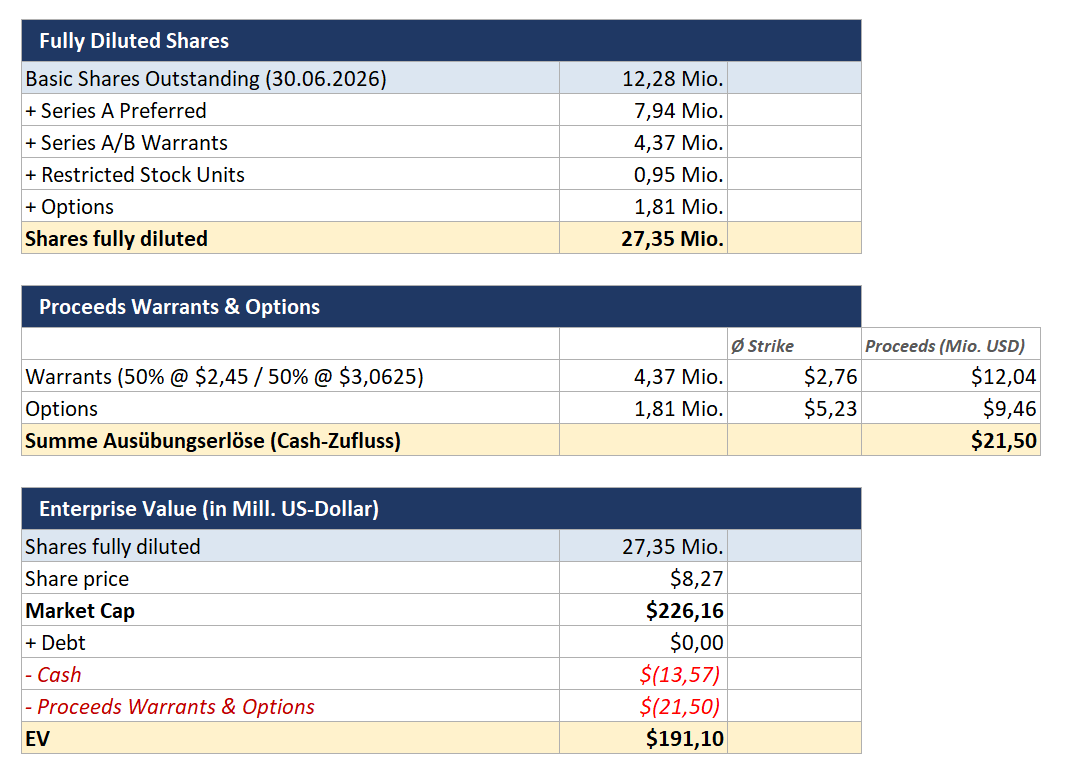
So you are looking at approximately 2.9x EV/Revenue run-rate. If you are new to medtech, that isn’t nearly as expensive as it might sound, especially considering Alcon agreed to pay 8x revenue. Of course, LENSAR was a fast-growing competitor taking market share at the time, but even now, you don’t need much imagination around ongoing system sales and procedure growth to see a compelling setup. I wouldn’t be surprised if we are looking at an $80M+ run-rate business by the end of the year. Even without international distributors coming back immediately.
Risks and things that haven't been mentioned yet
There are a few additional risk factors you should be aware of if you are considering an investment:
The warrants and preferred shares are both held by North Run Capital. They hold two board seats and approximately 45.4% of the total voting power, giving them primary control over major corporate decisions.
If international distributor re-engagement fails or lags significantly, a meaningful portion of the expected growth upside could be lost.
Future acquirers might hesitate to approach LENSAR after seeing the FTC-driven deal termination with Alcon, particularly if they already hold a competing cataract product line.
Don’t treat the recent normalized Adjusted EBITDA baseline of $2.5M as a fixed quarterly floor. Management has already indicated that OpEx will rise to support higher placement velocity going forward. A trade-off shareholders should welcome as long as it drives long-term system expansion.
Q3 combines a seasonally weak quarter with higher OpEx, so yesterday’s buyers might lose confidence if numbers dip. For the same reason, placements and backlog might need to hold at least current levels to maintain momentum.
Include all standard industry risks covering reimbursement policies, competitive landscape, and regulatory considerations.
Conclusion
Given how long I’ve been watching this from the sidelines, I’m glad a window has finally opened where I can confidently become a shareholder. I’ve repeatedly pointed to LENSAR as one of the highest-quality medtech businesses in the micro-cap space.
Valuation might look high on paper, but we already have third-party validation from a strategic buyer that it was worth a much higher multiple on its original trajectory. At current levels, not everything even needs to go right immediately to justify the price, given how strong that high-margin recurring revenue base is.
https://app.tracktacle.com/publication/doc/LNSR_3461394?source=TRANSCRIPT&format=html
https://app.tracktacle.com/publication/doc/LNSR_3461394?source=TRANSCRIPT&format=html
https://app.tracktacle.com/publication/doc/0001193125-25-060906?source=SEC&format=pdf
https://app.tracktacle.com/publication/doc/0001193125-25-125116?source=SEC&format=pdf
https://www.myalcon.com/international/professional/cataract-surgery/
https://app.tracktacle.com/publication/NEWS/7122747090323171
https://app.tracktacle.com/publication/doc/0001193125-26-134587?source=SEC&format=pdf
https://app.tracktacle.com/publication/doc/LNSR_3483617?source=TRANSCRIPT&format=html
https://app.tracktacle.com/publication/doc/0001193125-26-134587?source=SEC&format=pdf
https://app.tracktacle.com/publication/doc/0001193125-26-347859?source=SEC&format=pdf
What are your views on the competitive environment for $lnsr? Looks like many competing products and recently B/L just received approval for their new platform SeeLyra? Not much differentiation between products. Small moat?